


Currency is more than just money. It is a nation’s identity, a reflection of its economy, culture, and history. Every time we hold a banknote or see a currency symbol, we are interacting with a powerful symbol of national pride and global influence. As international travel, trade, and digital payments grow, understanding world currencies and their symbols has become an essential part of global literacy.
According to the International Standards Organization (ISO), there are 180 officially recognized currencies in circulation today, but only a handful dominate global trade. Each of these currencies has its own unique symbol, abbreviation, and cultural meaning. For instance, the U.S. Dollar (USD) symbol “$” is instantly recognizable worldwide, while the Indian Rupee (INR) symbol “₹” reflects a blend of tradition and modern India’s digital-first economy.
This blog is a complete, reader-friendly guide that explores the world’s currencies, their symbols, their stories, and their significance. Whether you’re a student, traveler, investor, or simply curious, this detailed guide will help you understand how the monetary world works—one currency at a time.
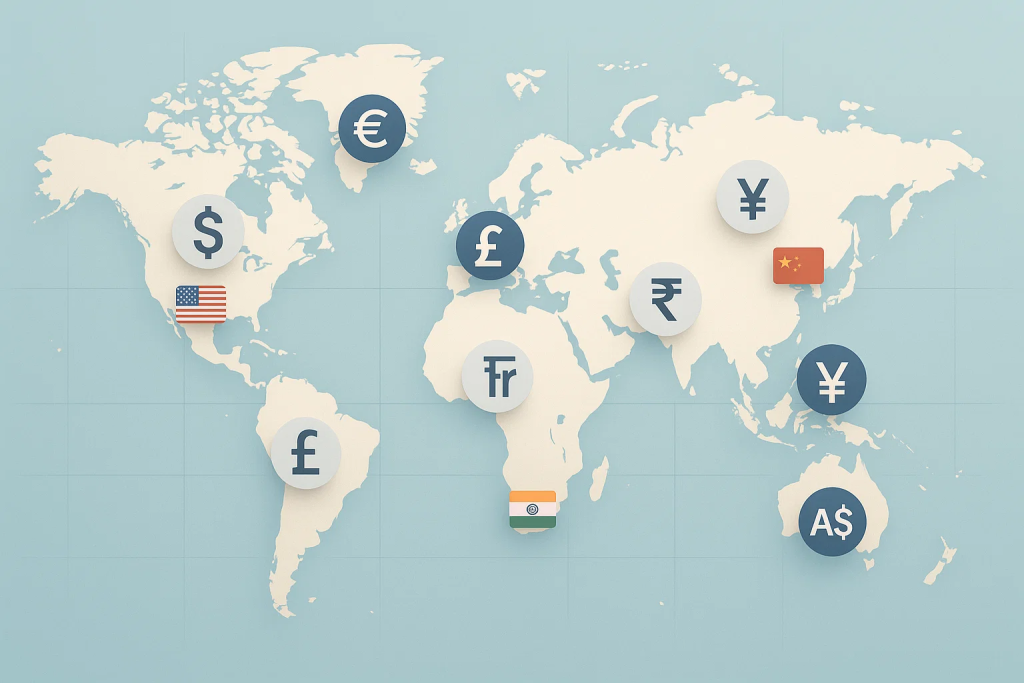
A Brief History and Evolution of Currency
The story of currency stretches back more than 5,000 years. Humanity began with simple barter systems, where people exchanged goods directly—grain for tools, livestock for cloth. However, barter had limitations because not everything matched in value, and not all trades were convenient.
Civilizations slowly shifted to using commodity money, such as cowrie shells, salt, copper, and later, precious metals like gold and silver. The earliest known minted coins appeared around 600 BCE in ancient Lydia (modern-day Turkey). These coins established the foundation for standardized value.
Paper money emerged in China during the Tang Dynasty (7th century) and became globally common by the 1600s as governments needed efficient ways to manage trade and taxation. With modernization and technological transformation, currency moved into the era of banknotes, cheques, electronic payments, and now digital forms like cryptocurrencies.
By the 20th century, countries began designing unique currency symbols to unify identity. For example, India adopted the “₹” symbol in 2010 to strengthen global recognition. Today, currencies are not just financial tools—they are economic indicators and national symbols.
Why Currencies and Their Symbols Matter
A currency symbol may look simple, but it carries enormous meaning. It helps differentiate currencies (like $ for USD, CAD, AUD), builds economic trust, and creates a consistent representation worldwide. In global markets, ambiguity can lead to million-dollar mistakes, which is why symbols are crucial for clarity.
Symbols also serve as cultural ambassadors. The British Pound symbol “£” traces its origin to the Latin word libra, reflecting centuries of economic history. The Euro symbol “€” represents unity among the nations of the European Union. Meanwhile, the Japanese Yen’s “¥” symbol reflects precision and stability—values deeply tied to Japan’s identity.
Currencies also influence global rankings. According to the IMF (International Monetary Fund), over 60% of global foreign exchange reserves are held in U.S. Dollars, making it the most dominant currency. The Euro accounts for about 20%, while currencies like the Japanese Yen and British Pound also play major global roles.
Understanding these dynamics helps people make better decisions in travel, business, investing, and global trade.If you want a practical example of how a major currency behaves against the rupee, see our guide on Euro to Indian Currency.
Travel situations often make currency differences more visible — for example during international trips like Christmas in Vietnam, where understanding local currency helps avoid confusion.
Major Currencies of the World and Their Symbols
The world uses 180 currencies, but only a few dominate travel, trade, technology, and financial markets. Below, we begin exploring some of the most influential ones—focusing on their symbols, significance, and interesting facts. (More currencies continue in the next batch.)
1. The United States Dollar – USD ($)
The U.S. Dollar is the world’s most recognized and widely traded currency. Its symbol “$” is believed to have evolved from the Spanish peso, where the letters “P” and “S” were written over each other and eventually simplified into the modern dollar sign.
Today, the U.S. Dollar is the global reserve currency, meaning that most international commodities—oil, gold, technology, aviation—are priced in USD. More than 80% of global forex transactions involve the dollar, making it the backbone of global finance. The strength of the USD often influences inflation, interest rates, and economic policies in many countries.
2. The Euro – EUR (€)
The Euro is the official currency of 20 European Union countries, collectively known as the Eurozone. Introduced in 1999, it quickly became the second-most powerful global currency. The symbol “€” is inspired by the Greek letter epsilon, representing Europe’s historical roots, with two horizontal lines symbolizing stability.
The Euro is used by over 340 million people daily, and it accounts for around 20% of the world’s foreign exchange reserves. It simplifies trade and travel across Europe, making it one of the world’s most successful currency unions.
3. The British Pound Sterling – GBP (£)
The Pound Sterling is the world’s oldest currency still in use, dating back to over 1,200 years. Its symbol “£” comes from the Latin word libra, meaning balance or weight. The Pound is often seen as a symbol of Britain’s long economic and colonial history.
The GBP remains one of the strongest currencies in terms of value, often ranking above the USD in exchange rate comparisons. London, being a global financial hub, contributes heavily to the Pound’s international status.
4. The Japanese Yen – JPY (¥)
The Yen, introduced in 1871, is Asia’s most traded currency. Its symbol “¥” resembles two parallel horizontal lines crossing through the letter Y, representing stability and structure—attributes strongly associated with Japanese culture.
Japan’s economy is the world’s third-largest, and the Yen is a preferred currency in global investments, especially during market uncertainty. This has earned it the title of a “safe-haven currency.”
5. The Indian Rupee – INR (₹)
The Indian Rupee’s symbol “₹” was officially adopted in 2010 after a national design competition. It combines the Devanagari letter “र” (Ra) and the Latin letter “R” with two horizontal bars representing the Indian tricolor and economic stability.
India’s currency has a rich history—from ancient punch-marked coins to modern digital payments. Today, the Rupee is used by over 1.4 billion people, making it one of the most widely circulated currencies in the world.
6. The Swiss Franc – CHF (Fr or SFr)
The Swiss Franc is the official currency of Switzerland and Liechtenstein, and it carries a reputation similar to the country itself—stability, safety, and reliability. Unlike many currencies, the Franc doesn’t have a stylized letter symbol like $, €, or ¥. Instead, it uses “Fr” or sometimes “CHF”, derived from Confoederatio Helvetica Franc, the Latin name for the Swiss Confederation.
The Swiss economy is known for its neutrality, wealth management, and strong banking system. These characteristics have allowed the Franc to become another safe-haven currency, especially during global financial uncertainty. Investors often buy CHF when other markets seem shaky. Switzerland’s strict monetary policies and low inflation rates give the Franc a reputation for long-term value protection.
7. The Canadian Dollar – CAD ($ or C$)
The Canadian Dollar shares the same symbol as the U.S. Dollar, but internationally it’s often written as C$ to avoid confusion. Commonly referred to as the “loonie”—named after the bird depicted on its one-dollar coin—the CAD is one of the world’s top traded currencies.
Canada’s role as a major exporter of oil, natural gas, and minerals ties the value of its currency to global commodity prices. When oil prices rise, the Canadian Dollar typically strengthens. The CAD also serves as a benchmark currency in the Americas, making it important in trade across the region.
8. The Australian Dollar – AUD (A$)
The Australian Dollar is another commodity-driven currency. Its symbol is similar to USD ($), but is often written as A$ for clarity. Australia’s large exports of iron ore, coal, gold, and agricultural products make the AUD responsive to market demand.
The Australian economy is considered highly resilient, which gives the AUD a strong international presence. It is widely used in Asia-Pacific trade and is among the top five most traded currencies in the world. The country’s multicultural identity is often reflected in its colorful and visually striking polymer banknotes—Australia was actually the first country to introduce polymer currency in 1988, inspiring many nations to adopt it later.
9. The Chinese Yuan – CNY (¥)
China’s official currency, the Yuan, also uses a symbol similar to the Yen (¥), though its font and design differ slightly. Often called the Renminbi (RMB), meaning “the people’s currency,” the CNY has been rapidly gaining global attention due to China’s massive economic growth.
With China being the world’s second-largest economy, the Yuan plays a major role in global manufacturing and trade. In 2016, it became part of the IMF’s Special Drawing Rights (SDR) basket—a huge milestone—placing it in the same category as the USD, EUR, GBP, and JPY. This recognition signaled China’s growing influence in international finance.
10. The UAE Dirham – AED (د.إ)
The United Arab Emirates uses the Dirham, symbolized in Arabic as “د.إ”. The UAE is a global hub for tourism, trade, aviation, and technology, especially cities like Dubai and Abu Dhabi. This has made the Dirham one of the most recognized Middle Eastern currencies.
The AED is pegged to the U.S. Dollar, meaning its value remains stable in relation to USD. This stability helps attract millions of expatriates and international investors, making the Dirham essential for global business travelers and workers across the Gulf region.
11. The Singapore Dollar – SGD (S$)
The Singapore Dollar is another strong Asian currency. Represented by S$, it is known for its stability and strong monetary policies. Singapore’s position as a global financial hub has resulted in the SGD becoming one of Asia’s safest and most trusted currencies.
The Monetary Authority of Singapore (MAS) follows a unique policy of using exchange rate bands rather than interest rates to manage inflation. This advanced monetary system keeps the Singapore Dollar strong and respected in international trade and banking.
Regional Currency Systems and Grouped Currencies
While most countries have their own national currencies, some regions use shared currencies or currency unions for economic convenience and political cooperation. These systems help reduce exchange complexities and strengthen regional markets.
a. The Eurozone (Europe)
The Euro is used by 20 EU countries, forming one of the largest economic blocs in the world. Eurozone membership simplifies trade and travel because countries no longer need to exchange local currencies. This economic integration has strengthened Europe’s global financial presence.
b. The CFA Franc (West & Central Africa)
In parts of Africa, 14 countries use the CFA Franc, divided into West African and Central African versions. Both are pegged to the Euro, providing currency stability in regions with diverse economies.
c. Caribbean Dollar System
Several Caribbean nations share common currencies, like the Eastern Caribbean Dollar (XCD). This unified system helps small island countries maintain stable financial systems and reduce currency management costs.
Interesting and Lesser-Known Currency Facts
Currencies often carry stories that go beyond economics—they reflect culture, history, and innovation.
In Japan, for instance, the Yen coins have tiny holes in the center of certain denominations, making them easy to differentiate by touch—an accessibility feature for visually impaired citizens. Meanwhile, in Canada and Australia, the widespread use of polymer banknotes has reduced counterfeiting significantly.
India’s Rupee has had countless design evolutions, from ancient punch-marked coins to modern RBI notes with Gandhi’s portrait. The United Kingdom features monarchs on its notes, a tradition maintained for centuries, with new portraits issued after the accession of each monarch.
One of the most interesting facts is that the strongest currency in the world is not the Dollar, Euro, or Pound—it is the Kuwaiti Dinar (KWD), due to Kuwait’s oil-backed economy and limited currency circulation. Similarly, Venezuela’s Bolívar and Zimbabwean Dollar are known for hyperinflation, where banknotes can lose value rapidly, showing the extreme impact of economic instability.
More Important Currencies Used Across the World
While the most powerful global currencies frequently appear in news headlines, many other currencies shape regional economies, tourism, and trade. Understanding them provides a clearer picture of global financial diversity.
a. The South African Rand – ZAR (R)
The South African Rand, symbolized as R, is the official currency of South Africa and is influential across the African continent. Its name comes from “Witwatersrand,” the ridge where Johannesburg’s gold deposits were discovered. South Africa’s history as one of the world’s largest gold producers links the Rand strongly to global commodity prices. The Rand often fluctuates based on political developments, economic reforms, and investor confidence, making it a reflection of Africa’s most industrialized economy.
b. The Saudi Riyal – SAR (﷼)
The Saudi Riyal uses the Arabic symbol ﷼. As the currency of the world’s largest oil exporter, it plays a crucial role in global energy markets. Like the UAE Dirham, the Riyal is pegged to the U.S. Dollar, maintaining predictable stability for oil pricing and trade. Saudi Arabia’s Vision 2030 initiative, aimed at diversifying its economy, further strengthens the global relevance of its currency.
c. The Brazilian Real – BRL (R$)
Brazil’s currency, the Real, symbolized as R$, is one of the most important currencies in Latin America. Introduced in 1994 to control hyperinflation, the Real helped stabilize Brazil’s economy significantly. Today, Brazil’s status as a member of BRICS, along with Russia, India, China, and South Africa, contributes to the Real’s importance in global emerging markets.
d. The Russian Ruble – RUB (₽)
The Russian Ruble uses the symbol ₽, which was officially adopted in 2013. Russia’s currency holds global attention due to the country’s influence in energy markets, geopolitical developments, and its role within BRICS. Sanctions, international trade restrictions, and political tensions often cause sharp fluctuations in the Ruble’s value, making it one of the more volatile major currencies.
e. The South Korean Won – KRW (₩)
The South Korean Won is symbolized as ₩. South Korea’s transformation from a war-torn nation in the 1950s to a global tech leader today is reflected in the stability of the Won. The country’s thriving electronics, automotive, and entertainment industries—led by brands like Samsung, Hyundai, and the global rise of K-culture—have strengthened the Won’s international standing. As Asia continues to grow economically, the Won has become a currency to watch.
Digital Currencies and the Future of Money
As technology evolves, money is changing faster than ever. Digital currencies, both government-backed and decentralized, are reshaping how people pay, invest, and save.
Cryptocurrencies like Bitcoin, Ethereum, Binance Coin, and stablecoins like USDT have gained worldwide attention. Bitcoin’s symbol ₿ is now recognized globally, just like $ or €. Although volatile, Bitcoin has been called “digital gold” and used as an investment asset by many. Ethereum’s symbol Ξ represents its role as the foundation of smart contracts and Web3 applications.
Alongside crypto, many governments are developing Central Bank Digital Currencies (CBDCs).
India introduced its digital rupee pilot in 2022, aiming to create a faster, safer, regulated digital payment ecosystem.
China is leading with its Digital Yuan (e-CNY), already tested across millions of users.
Digital currency systems are designed to reduce cash dependency, enhance transaction security, and improve global payment efficiency. This shift signals that while traditional currencies remain dominant, the future of money will combine physical, digital, and decentralized forms.
How Currency Symbols Are Created
Currency symbols often seem simple, but their design process is detailed and historically meaningful. Most symbols originate from the first letters of a currency’s name or from ancient scripts. The British Pound’s “£” came from the Latin word libra, while the U.S. Dollar’s “$” evolved from the Spanish peso.
Modern symbol creation is far more structured. The Indian Rupee symbol “₹” was selected through a national design competition that received over 3,000 entries. The Euro “€” was designed by the European Commission, inspired by classical Greek letters, symbolizing shared European identity.
Currency symbols must be distinct enough to avoid confusion, easy to write by hand, compatible with digital keyboards, and represent national pride. They become long-term visual ambassadors of a country’s economic image.
How Currencies Influence Global Trade and Economies
Currencies are not just tools of exchange—they shape global politics, trade relationships, and investment flows. A strong currency typically indicates economic confidence, low inflation, and foreign investment. A weakening currency might reflect trade deficits, political instability, or economic challenges.
For example, when the U.S. Dollar strengthens, imports become cheaper for Americans, but other countries may see rising import costs. When the Euro fluctuates, it affects the entire European market. And when the Yen rises, Japanese exports become more expensive, influencing global electronics and automobile markets.
Countries often intervene to stabilize their currencies. China, for example, tightly manages the Yuan’s value to support its export-driven economy. Meanwhile, nations with volatile currencies—like Turkey or Argentina—struggle to maintain purchasing power and economic stability.
Currency values can influence tourism, foreign investment, inflation, employment, and trade competitiveness. This interconnectedness shows why understanding currencies is not only useful for travelers or investors but crucial for interpreting global economic trends.
In fact, platforms like Videshi Mudra help people navigate these fluctuations by offering transparent exchange rates and reliable access to foreign currencies, ensuring travellers and businesses stay better prepared in a constantly shifting global currency landscape.
Conclusion
Currencies are much more than pieces of paper or digital numbers on a screen — they tell the story of a nation’s journey, identity, and place in the world. Whether it is the mighty U.S. Dollar that drives global trade, the Euro that unites diverse nations, the British Pound that carries centuries of history, or the Indian Rupee that reflects the aspirations of one of the world’s fastest-growing economies, each currency symbol represents trust, sovereignty, and economic strength.
As we explored currencies from different continents, we saw how deeply money is interwoven with culture, politics, and national character. We also saw how modern currencies are rapidly evolving, with digital currencies reshaping the future of finance. With over 180 currencies in circulation worldwide, understanding their symbols and significance is an essential part of becoming a globally aware citizen — whether you are a traveler planning your first international trip, a student studying world economics, or a business owner exploring foreign markets.
In a world increasingly connected by technology, trade, and communication, currencies continue to serve as the universal language of value. They help us buy, sell, invest, and dream. And behind every currency symbol lies a story — of history, resilience, and the future of global exchange.
FAQs
1. How many currencies are there in the world?
There are 180 officially recognized currencies according to the International Organization for Standardization (ISO). However, only a few dominate global trade, such as the USD, EUR, GBP, JPY, and CNY.
2. Which is the most powerful currency in the world?
The Kuwaiti Dinar (KWD) is currently the world’s strongest currency in terms of value. However, the U.S. Dollar is the most dominant and widely used in international trade.
3. Why do some currencies share the same symbol ($)?
Countries like the United States, Canada, and Australia use the “$” symbol because it evolved from the historic Spanish peso. To avoid confusion, prefixes like C$ (Canada) or A$ (Australia) are used.
4. What is the difference between CNY and RMB?
Both refer to China’s currency. RMB (Renminbi) is the official name meaning “People’s Currency,” while CNY (Yuan) is the unit used for trading and exchange rates.
5. Why are some currencies pegged to the U.S. Dollar?
Countries like Saudi Arabia and the UAE peg their currencies to the USD to maintain stability, control inflation, and ensure predictable trade in oil and global markets.
6. What is a currency union?
A currency union occurs when multiple countries use the same currency, such as the Eurozone, where 20 European nations use the Euro (€) for seamless trade and travel.
7. Are digital currencies the future of money?
Digital currencies are on the rise. Cryptocurrencies like Bitcoin (₿) and government-backed digital currencies like CBDCs are becoming increasingly common. They offer faster transactions and modern financial security, but traditional physical currencies will still coexist for decades.
8. How do countries choose their currency symbols?
Symbols are chosen based on cultural identity, linguistic roots, and visual simplicity. They must be easy to write, easy to type, and distinct enough to avoid confusion in global markets.
9. Why do exchange rates fluctuate?
Exchange rates change due to inflation, interest rates, political stability, demand for imports/exports, and global market sentiment. Strong economies generally have stable or rising currency values.
10. Why should travelers learn about world currencies?
Understanding world currencies helps avoid confusion, prevents scams, improves travel budgeting, and makes international transactions smoother and more secure.