

Introduction
When planning an international trip, most people focus on flights, hotels, and itineraries. But one important aspect that often gets overlooked is how you will manage your money abroad.
Carrying the right payment option can make a big difference in your travel experience. Whether it’s paying for meals, booking transport, or handling emergencies, having a reliable and cost-effective way to access money is essential.
Today, travelers usually choose between forex cards, debit cards, and credit cards. Each option comes with its own benefits, costs, and limitations. While some offer convenience, others provide better control over expenses or lower transaction charges.
The challenge is understanding which one suits your travel style and needs.
In this guide, we’ll break down the differences between these three options and help you decide what works best for your international journey.
Why Choosing the Right Payment Option Matters
Managing money abroad is not just about convenience—it’s also about cost, safety, and flexibility.
Different payment methods come with different charges such as:
- Currency conversion fees
- ATM withdrawal charges
- International transaction fees
Even small percentage differences can add up when you are spending over several days or weeks.
Another important factor is security. Losing cash or facing payment issues can disrupt your trip, especially in a foreign country.
This is why experienced travelers prefer a combination of payment methods rather than relying on a single option.
Choosing the right mix ensures that you are prepared for different situations—whether it’s a local market that only accepts cash or a hotel that requires card payment.
Understanding Forex Cards
A forex card is a prepaid card that you can load with foreign currency before your trip. It works similar to a debit or credit card but is specifically designed for international travel.
Once you load the card with a specific currency, you can use it for payments or ATM withdrawals in that currency.
One of the biggest advantages of a forex card is that it allows you to lock in exchange rates at the time of loading. This protects you from fluctuations in currency rates during your trip.
Forex cards are widely accepted at most international locations, including hotels, restaurants, and shopping outlets.
They also offer better control over spending, as you can only use the amount that is loaded onto the card.
For travelers who want predictability and control, forex cards are often considered a practical option.
Understanding Debit Cards for International Use
Debit cards are commonly used for both domestic and international transactions. When you use your debit card abroad, the amount is directly deducted from your bank account.
While debit cards offer convenience, they usually come with international transaction fees and currency conversion charges.
Additionally, each ATM withdrawal abroad may include extra charges from both your bank and the local ATM provider.
One advantage of debit cards is that they provide direct access to your funds, which can be useful in emergencies.
However, this also means that you need to be cautious about security, as any unauthorized transaction directly affects your bank balance.
Debit cards are useful as a backup option, but relying on them entirely may not always be cost-effective.
Understanding Credit Cards for International Travel
Credit cards are another popular option for international travelers, especially for larger expenses such as hotel bookings, flights, and shopping.
Unlike debit cards, credit cards allow you to borrow money up to a limit and repay it later.
They often come with added benefits such as:
- Reward points
- Travel perks
- Insurance coverage
However, credit cards also include foreign transaction fees and currency conversion charges.
If not managed properly, interest charges can also increase your overall expenses.
Credit cards are best suited for convenience and emergency use, but they require careful handling to avoid overspending.
Forex Card vs Debit Card vs Credit Card: Key Differences
While all three options allow you to spend money internationally, they work very differently in terms of cost, convenience, and control.
A forex card is prepaid, which means you load a specific amount before traveling. This gives you better control over spending and protects you from currency fluctuations. Since the rate is locked in advance, you know exactly how much you are spending.
Debit cards, on the other hand, are linked directly to your bank account. Every time you use them abroad, the amount is converted at the prevailing exchange rate, along with additional charges. This can make the final cost slightly unpredictable.
Credit cards offer flexibility and convenience, especially for large transactions. However, they often come with higher foreign transaction fees and interest charges if payments are not cleared on time.
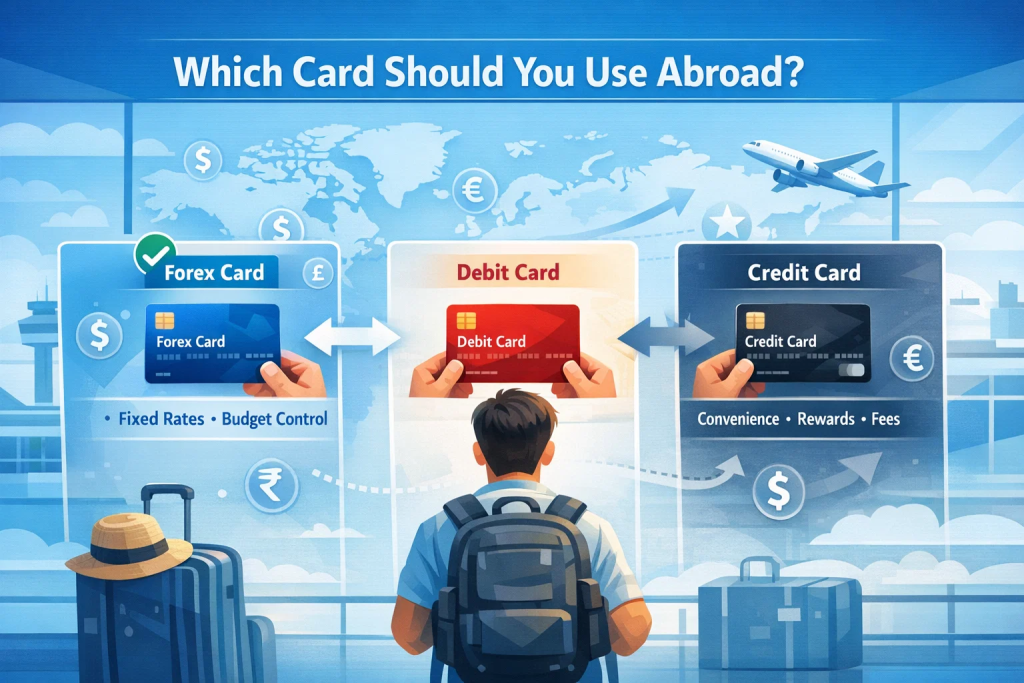
When you compare these options, the difference becomes clearer—forex cards are about control and predictability, debit cards provide direct access to funds, and credit cards offer flexibility with added responsibility.
Cost Comparison: What You Actually Pay
Cost is one of the most important factors when choosing a payment method for international travel.
With forex cards, you typically pay a one-time loading charge and possibly a small fee for ATM withdrawals. Since the exchange rate is fixed at the time of loading, you avoid unexpected fluctuations.
Debit cards often include multiple charges, such as international transaction fees, currency conversion charges, and ATM withdrawal fees. These costs can add up quickly, especially if you use your card frequently.
Credit cards also include foreign transaction fees, and in some cases, dynamic currency conversion charges. If the outstanding balance is not paid on time, interest charges can significantly increase your expenses.
Over a longer trip, these differences can have a noticeable impact on your overall budget.
Convenience and Acceptance Across Countries
All three options are widely accepted globally, but their usage can vary depending on the location.
Forex cards are commonly accepted at most places that accept card payments. They are especially useful in countries where card usage is widespread.
Debit cards are also accepted globally, but ATM access may vary depending on the location. In some areas, finding compatible ATMs can be a challenge.
Credit cards are highly accepted for major expenses like hotels, shopping, and online bookings. However, smaller vendors and local markets may not always accept them.
This is why relying on a single payment method is not always ideal.
Safety and Risk Factors
Safety is a major concern when handling money abroad.
Forex cards are generally considered safer because they are prepaid. Even if the card is lost, the financial risk is limited to the loaded amount.
Debit cards carry higher risk since they are linked directly to your bank account. Any unauthorized transaction can impact your account balance immediately.
Credit cards offer an added layer of protection, as fraudulent transactions can often be disputed. However, they also come with the risk of overspending.
Understanding these risks helps you choose a safer and more balanced approach.
Real-Life Scenarios: When to Use What
To understand this better, let’s look at how these options work in real situations.
When you arrive in a new country, you may need to pay for transport, food, or small expenses. In such cases, having access to prepaid funds through a forex card can be convenient and controlled.
For hotel bookings or larger purchases, credit cards are often preferred due to their wide acceptance and ease of use.
In case of emergencies, a debit card can help you withdraw cash directly from your bank account.
Each option has its own role, and using them together can make your travel experience smoother.
Why a Combination Works Better Than a Single Option
Instead of choosing one option, many experienced travelers prefer to use a combination of all three.
A forex card can be used for regular spending, a credit card for large payments, and a debit card as a backup.
This approach provides flexibility, reduces risk, and ensures that you are prepared for different situations.
Planning your forex in advance—whether through a reliable provider like Princess Forex or other authorized services—helps you create a balanced and efficient strategy.
Common Mistakes Travelers Make While Choosing Payment Options
Even though travelers have multiple payment options today, many still make simple mistakes that can increase their costs or create inconvenience during the trip.
One of the most common mistakes is relying on a single payment method. For example, carrying only a debit card or only a credit card can create problems if it doesn’t work in certain locations.
Another frequent issue is ignoring hidden charges. Many people focus only on the exchange rate and overlook additional costs like foreign transaction fees, ATM charges, or conversion margins.
Some travelers also tend to delay forex planning until the last moment, which reduces their ability to compare options and get better rates.
There is also a lack of awareness about currency fluctuations, especially when using debit or credit cards where the final amount depends on real-time conversion rates.
Lastly, not informing the bank before international travel can sometimes lead to card blocks or transaction issues.
Avoiding these mistakes can make your travel experience much smoother and more cost-effective.
How to Choose the Right Option Based on Your Travel Style
Choosing the best payment option depends on how you plan to travel and spend.
If your trip involves daily expenses like food, transport, and small purchases, a forex card can provide better control and predictability.
For travelers who prefer flexibility and want access to additional funds, credit cards can be useful, especially for larger expenses.
If you want a backup option for emergencies, debit cards can be helpful for withdrawing cash when needed.
For short trips, you may not need to rely heavily on multiple options, but for longer or multi-country trips, a combination becomes more important.
Understanding your travel style helps you choose the right mix of payment methods.
Smart Strategy for Managing Money Abroad
A well-balanced strategy is the key to managing your money efficiently during international travel.
Instead of depending on one option, it’s better to distribute your funds across different methods.
You can use a forex card for most of your daily expenses, ensuring that your spending remains controlled and predictable.
A credit card can be used for larger payments like hotel bookings or shopping, where acceptance is higher.
A debit card can act as a backup, allowing you to withdraw cash if required.
It is also advisable to carry a small amount of foreign currency in cash for situations where digital payments are not accepted.
Planning your forex through reliable providers like Princess Forex can help you organize your funds efficiently before your trip begins.
Tips to Reduce Costs During International Transactions
Managing your expenses abroad is not just about choosing the right payment method—it’s also about using it wisely.
Avoid frequent ATM withdrawals, as each transaction may include additional charges.
Whenever possible, choose to pay in the local currency instead of your home currency to avoid dynamic currency conversion fees.
Keep track of your spending regularly so you don’t exceed your planned budget.
It is also helpful to check live exchange rates before making any major transaction.
Being aware of these small details can help you save a significant amount over the course of your trip.
Preparing Before You Travel
Preparation plays a key role in ensuring a smooth experience.
Before traveling, inform your bank about your international usage plans to avoid any transaction blocks.
Check whether your cards are enabled for international transactions and understand the applicable charges.
Make sure your forex card is loaded with sufficient funds based on your itinerary.
Keep emergency contact numbers for your bank or card provider in case you face any issues abroad.
A little preparation can help you avoid unnecessary stress during your trip.
Conclusion
Choosing between a forex card, debit card, and credit card for international travel is not about picking a single “best” option—it’s about understanding how each one fits into your travel needs.
Each payment method serves a different purpose. Forex cards offer control and protection from currency fluctuations, debit cards provide direct access to your funds, and credit cards bring convenience for larger transactions.
The smartest approach is to use a combination of all three, ensuring that you are prepared for different situations while managing costs effectively.
By planning your forex in advance, understanding charges, and selecting the right mix of payment options, you can make your travel experience smoother and more stress-free.
Working with reliable forex providers like Princess Forex also helps ensure that your currency planning is organized and aligned with your travel needs.
At the end of the day, international travel is about enjoying new experiences—and with the right financial preparation, you can focus on your journey without worrying about money management.
FAQs
1. Which is better: forex card, debit card, or credit card?
There is no single best option. A combination of all three works best for flexibility and safety.
2. Are forex cards cheaper than debit or credit cards?
Forex cards can be more cost-effective as they allow you to lock exchange rates and avoid frequent conversion charges.
3. Can I use my debit card internationally?
Yes, but it may include international transaction fees and ATM charges.
4. Are credit cards safe for international travel?
Yes, they offer good security and are widely accepted, but they should be used carefully to avoid high charges.
5. Should I carry cash along with cards?
Yes, carrying a small amount of foreign currency is helpful for places where cards are not accepted.
6. Do forex cards work in all countries?
Forex cards are widely accepted, but acceptance may vary in remote areas.
7. What are foreign transaction fees?
These are charges applied when you use your card in a foreign currency.
8. Can I withdraw cash using a forex card?
Yes, you can withdraw cash from international ATMs using a forex card.
9. Is it safe to rely only on one payment method?
No, it is always better to have multiple options to avoid inconvenience.
10. When should I plan my forex before travel?
It is best to plan and arrange your forex a few days or weeks before your trip.