

Introduction
Foreign exchange is an essential part of international travel, education, and global financial transactions. Whether you are buying foreign currency for a vacation, sending money abroad, or receiving funds from overseas, one factor that often goes unnoticed is GST (Goods and Services Tax) on forex transactions.
Many people assume that currency exchange is only about the exchange rate, but in reality, there are additional charges involved — and GST is one of them. Understanding how GST applies to foreign exchange transactions can help you make more informed financial decisions and avoid unexpected costs.
In India, GST is not directly applied on the entire currency amount. Instead, it is calculated on the service component (forex margin) that the provider earns during the transaction. This makes the concept slightly technical, but once simplified, it becomes much easier to understand.
In this guide, we will break down how GST works on foreign exchange in India, how it is calculated, when it applies, and what travelers and NRIs should know before making forex transactions in 2026.
What Is GST on Foreign Exchange?
GST on foreign exchange refers to the tax charged on the service provided by forex dealers during currency conversion.
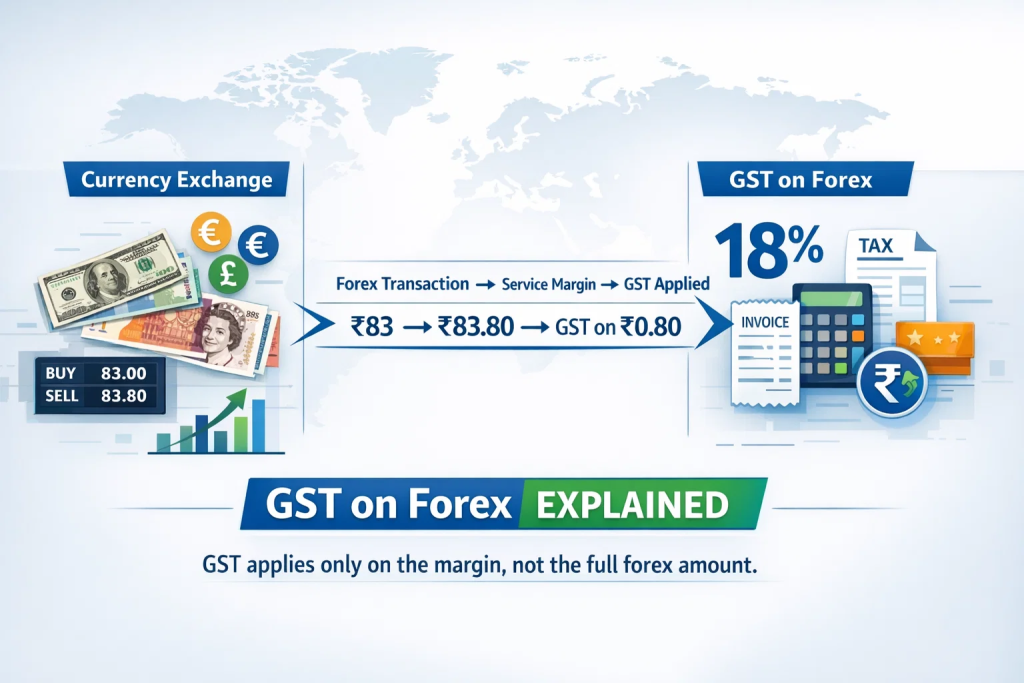
When you exchange currency, the provider earns a small margin between the buying rate and selling rate. This margin is considered a service, and GST is applied to this service value — not the total currency exchanged.
For example, if you are buying US Dollars, the rate you receive includes a small markup over the market rate. This markup is where the service component lies, and GST is calculated on this portion.
Currently, the applicable GST rate on forex services in India is 18%, but it is important to note that this 18% is not applied to the full transaction amount — only to the calculated service value.
Understanding this distinction helps avoid confusion, as many people mistakenly believe that GST significantly increases the total forex cost.
How GST on Forex Is Calculated
GST calculation on foreign exchange is slightly different from standard product taxation because it is based on the value of service, not the transaction amount.
There are generally two methods used to calculate the taxable value for GST in forex transactions.
Method 1: Based on Forex Margin
In this method, GST is calculated on the difference between the exchange rate offered by the provider and the RBI reference rate.
For example, if the RBI reference rate for USD is ₹83 and the provider offers ₹83.80, the difference of ₹0.80 is considered the service value. GST is then applied to this margin.
This method is commonly used when the RBI reference rate is available for the currency.
Method 2: Slab-Based Calculation
If the RBI reference rate is not available, GST is calculated based on predefined slabs:
- For transactions up to ₹1,00,000 → 1% of the gross amount (minimum ₹250)
- ₹1,00,001 to ₹10,00,000 → ₹1,000 + 0.5% of amount exceeding ₹1,00,000
- Above ₹10,00,000 → ₹5,500 + 0.1% of amount exceeding ₹10,00,000
GST is then applied on the value derived from these slabs.
This method ensures that GST calculation remains standardized even when direct rate comparison is not possible.
When Does GST Apply in Forex Transactions?
GST applies to most foreign exchange-related services in India. These include:
- Buying foreign currency
- Selling foreign currency
- Currency conversion services
- International remittance services
Whether you are a traveler exchanging currency or an NRI transferring funds, GST may be applicable depending on the nature of the transaction.
However, the impact of GST varies depending on the type and size of the transaction, as well as the margin applied by the forex provider.
Why Understanding GST Matters for Travelers
For travelers, forex planning often focuses on exchange rates, but GST is an additional factor that can affect the final cost.
Even though GST is applied only on the service component, it still contributes to the overall expense of currency exchange. Understanding this helps travelers evaluate the true cost of forex, rather than focusing only on the visible exchange rate.
For example, two providers may offer similar exchange rates, but differences in margin and GST calculation can result in different final costs.
This is why informed travelers often compare both the exchange rate and total cost breakdown before making a decision.
GST on Forex for NRIs and International Transfers
GST is also relevant for NRIs and individuals involved in international money transfers.
When funds are transferred abroad or converted between currencies, forex services are involved, and GST may apply to the service component.
For NRIs transferring funds from India, understanding GST helps in evaluating the overall cost of the transaction.
It also ensures transparency when dealing with banks or forex providers, as customers can better understand the charges applied.
Real Example of GST on Forex Transactions
To make things clearer, let’s understand GST on forex with a simple example.
Suppose you want to buy USD 1,000, and the RBI reference rate is ₹83. Your forex provider offers you the currency at ₹83.80.
Here, the difference of ₹0.80 per dollar is the service margin.
So, the total margin becomes ₹800 (0.80 × 1000).
GST at 18% will be applied on ₹800, which comes to ₹144.
So, while your main cost is based on the exchange rate, this GST amount is added to the overall cost of the transaction.
This example shows that GST is not applied to the full ₹83,800 amount, but only on the margin — which makes a big difference in understanding the actual cost.
Hidden Cost Awareness in Forex Transactions
Many people focus only on the exchange rate and overlook other components of forex pricing.
While GST is transparent and clearly defined, the forex margin itself varies across providers, which indirectly affects how much GST you pay.
A higher margin means a higher taxable value, which leads to slightly higher GST.
This is why comparing providers based only on the visible exchange rate is not always enough. Looking at the overall cost structure, including margins and applicable GST, gives a clearer picture.
Being aware of these components helps you make smarter and more cost-effective decisions.
How to Reduce Forex Costs Despite GST
While GST is a fixed tax and cannot be avoided, there are ways to manage your overall forex cost effectively.
One of the simplest approaches is to compare rates across authorized providers. Even small differences in margin can impact your total cost.
Planning your forex in advance can also help. Last-minute exchanges often come with higher margins, which increases both the service cost and the GST applied on it.
Another useful approach is to avoid multiple small transactions. Each transaction may include a service component, so consolidating your forex needs into fewer transactions can help reduce overall charges.
Working with reliable providers like Princess Forex can also help you get transparent pricing and better clarity on charges, allowing you to make informed decisions.
Common Misconceptions About GST on Forex
There are several misconceptions about how GST works in foreign exchange transactions.
One of the most common myths is that GST is applied to the entire currency amount. In reality, it is only applied to the service component or margin.
Another misconception is that GST significantly increases forex costs. While it does add to the cost, its impact is relatively small compared to the exchange rate itself.
Some people also believe that GST rates vary depending on the transaction, but the standard rate for forex services remains consistent.
Clearing these misconceptions helps travelers and NRIs better understand their transactions and avoid unnecessary confusion.
How Forex Providers Handle GST Transparency
Reputed forex providers usually include GST as part of the transaction breakdown.
When you request a quote or complete a transaction, the total cost often reflects the exchange rate, service margin, and GST component.
Transparent providers ensure that customers are aware of all charges involved, helping build trust and clarity.
Choosing the right provider ensures that you are not only getting competitive rates but also a clear understanding of how your money is being calculated.
Conclusion
GST on foreign exchange in India may seem complex at first, but once you understand how it works, it becomes much easier to navigate.
The key takeaway is that GST is applied only on the service component, not on the full transaction amount. This makes its impact relatively limited compared to the overall exchange cost.
By understanding how GST is calculated, being aware of forex margins, and comparing providers effectively, you can make smarter financial decisions when dealing with foreign currency.
Whether you are a traveler, student, or NRI, having clarity on GST helps you manage your forex transactions with greater confidence and transparency.
With the right planning and awareness, you can ensure that your currency exchange experience remains efficient, cost-effective, and hassle-free.
FAQs
1. Is GST applied on the full forex amount?
No, GST is not applied to the entire foreign exchange amount. Instead, it is levied only on the service component or margin earned by the forex provider. This margin is essentially the difference between the rate offered to you and the reference rate (usually provided by the RBI). This ensures that GST is charged only on the service value and not on the principal amount being exchanged.
2. What is the GST rate on forex in India?
The standard GST rate applicable to foreign exchange services in India is 18%. However, this 18% is not charged on the total transaction value but only on the taxable portion, which is the service fee or margin. The actual GST amount you pay will therefore depend on how much margin the provider includes in the transaction.
3. How is GST calculated on currency exchange?
GST on forex transactions can be calculated in two ways:
- Rate difference method: Based on the difference between the exchange rate offered by the provider and the RBI reference rate.
- Slab-based method: A predefined valuation structure set by GST rules, where different transaction amounts fall into specific slabs, and GST is calculated accordingly.
The method used may vary depending on the provider and the nature of the transaction.
4. Does GST apply to both buying and selling currency?
Yes, GST applies to both buying and selling of foreign currency. Whether you are purchasing foreign currency for travel or converting it back to INR, the service component involved in the transaction is subject to GST. Essentially, any forex transaction involving a service provider will attract GST.
5. Can GST be avoided in forex transactions?
No, GST cannot be avoided as it is a mandatory tax regulated by the government. However, you can minimize your overall cost by comparing exchange rates, choosing providers with lower margins, and understanding the fee structure. A lower margin means a lower taxable amount, which indirectly reduces the GST you pay.
6. Why do different providers charge different amounts?
Different forex providers quote different rates because their margins vary. Since GST is calculated on this margin or service fee, a higher margin results in higher GST. Additionally, providers may include other service charges, processing fees, or convenience fees, which can further impact the total cost.
7. Is GST applicable on international money transfers?
Yes, GST may apply to international money transfers, but only on the service charges involved in the transaction. This includes fees charged by banks or remittance service providers. The actual foreign currency amount being transferred is not taxed—only the service portion is subject to GST.
8. Does GST affect forex cards?
Yes, GST applies to forex cards in certain situations. It is charged on service-related components such as card issuance fees, reloading charges, and sometimes currency conversion fees. While the card itself is a convenient tool, the associated service charges may include GST.
9. How can I check GST charges before exchange?
You can request a detailed breakdown of charges from your forex provider before completing the transaction. This should include the exchange rate, margin, service fees, and GST. Reviewing this breakdown helps you understand the total cost and avoid any hidden charges.
10. Is GST included in the quoted exchange rate?
GST may or may not be included in the quoted exchange rate, depending on the provider. Some providers bundle all charges into a single rate, while others show GST separately. It’s always advisable to confirm this in advance so you have a clear understanding of the final amount payable.